December 12, 2025

Tufte's Six Principles for Graphical Integrity

Edward Tufte's principles have defined the gold standard for data visualization for decades. This guide breaks down each principle with practical examples.

Who is Edward Tufte?
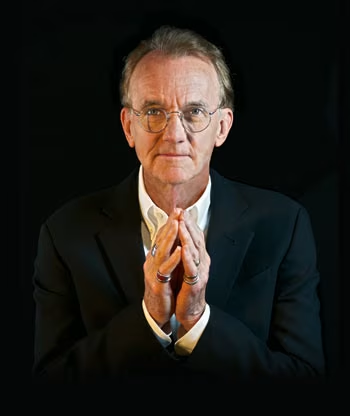
Edward Tufte - data visualization expert and Yale professor emeritus
Edward R. Tufte
Professor Emeritus, Yale University
© Andrei Severny

Edward Tufte is a statistician and professor emeritus at Yale University, often called the "Leonardo da Vinci of data."1 His 1983 book The Visual Display of Quantitative Information revolutionized how designers, journalists, and analysts think about presenting data.2

Tufte's core argument is simple but radical: graphical excellence is not about style - it's about truth.3 A chart should maximize the information conveyed while minimizing visual noise. Every pixel of ink should serve the data.

His influence extends far beyond academia. The Financial Times, The Economist, Bloomberg, and top consulting firms like McKinsey all build on his foundation.4 Their charts command attention because they follow these principles - treating data visualization as a form of intellectual honesty rather than decoration.

The Data-Ink Ratio5

Data-Ink Ratio = Data-Ink / Total Ink Used

A ratio of 1.0 means every drop of ink represents data. While this ideal is rarely achievable, Tufte argues designers should maximize this ratio by erasing non-data-ink (borders, backgrounds, unnecessary gridlines) and redundant data-ink (duplicate labels).4

"Above all else, show the data." - Edward Tufte
1. Show Data in Comparison

An isolated number is meaningless. Authority and insight come from context - showing how one value relates to others. The fundamental analytical question is always: "Compared to what?"6 Comparisons reveal differences, trends, and anomalies that single data points cannot show. Whether comparing across time periods, geographic regions, or different categories, juxtaposition creates meaning.

$4.2M Revenue Is this good or bad?

Weak: Isolated Data

A single number provides no context. Without comparison points, we cannot evaluate whether $4.2M represents success, failure, growth, or decline.

$3.1M 2022 $3.8M 2023 $4.2M 2024 +35.5%

Strong: Comparative Data

Multiple data points reveal the story: steady growth over 3 years with 35.5% total increase. The visualization instantly communicates performance and trajectory.

Fair Comparisons: The Lie Factor

Comparisons must be fair. Visual representations should accurately reflect the underlying data relationships. Tufte quantified this with his Lie Factor - a mathematical measure of how much a graphic deviates from numerical reality:7

Lie Factor = (Size of effect in graphic) / (Size of effect in data)

A Lie Factor of 1.0 indicates an honest graphic. Values between 0.95 and 1.05 are acceptable.

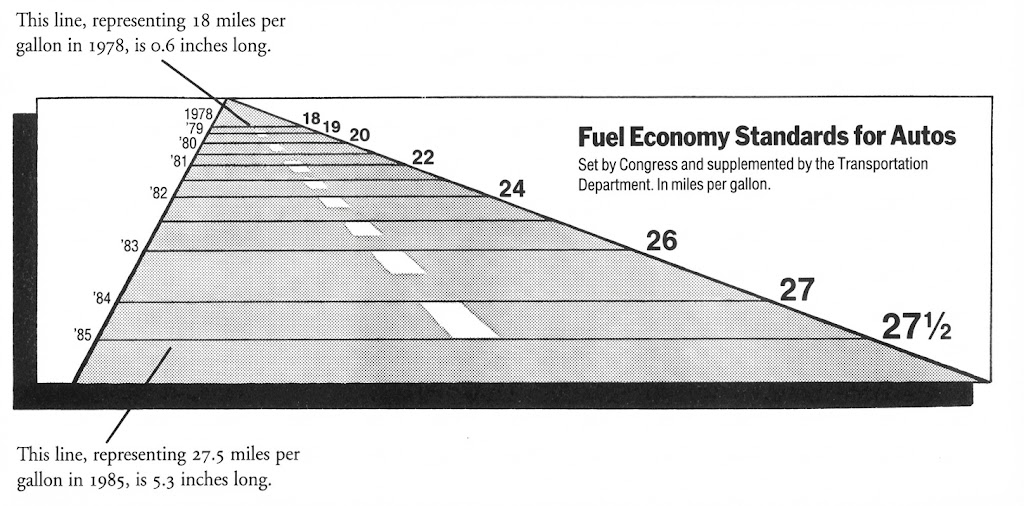
Case Study 1: Fuel Economy Standards - A Perspective Distortion

In 1978, The New York Times published a graphic showing fuel economy standards with severe perspective distortion, creating what Tufte called a "whopping lie."8

Original chart from Tufte's analysis demonstrating extreme visual distortion Lie Factor Analysis 14.8× Visual Change Line lengths: 0.6" to 5.3" 783% increase Data Change Values: 18 to 27.5 mpg 53% increase 783% ÷ 53% = 14.8 Perspective distortion grossly exaggerates the improvement

Common sources of high Lie Factors include: using area to represent one-dimensional data (creates a squared effect), truncating the y-axis to exaggerate differences (see bar graph best practices), and applying perspective that distorts relative sizes.

Case Study 2: The Broken Y-Axis Deception

Breaking the y-axis is a common technique to exaggerate small differences. By truncating the baseline, minor variations appear dramatic.9

With Broken Axis 80 77.5 75 72.5 Q1 Q2 Q3 Q4 72 74 73 76 With Full Axis (0-100) 100 75 50 25 0 Q1 Q2 Q3 Q4 72 74 73 76 Lie Factor Analysis 36× Visual Change Bar heights: 60px to 180px 200% increase Data Change Values: 72 to 76 5.6% increase 200% ÷ 5.6% = 36×

2. Demonstrate Causality

The best charts don't just show correlation - they suggest mechanism. They help viewers understand why something happened, not just that it happened. Tufte argues that effective graphics should reveal causality, mechanism, explanation, and systematic structure.

Why did it change?

Weak: Cause Unclear

Data changes without explanation leave viewers guessing about underlying factors. The narrative is incomplete without causal markers.

Launch Event Before After +58% effect

Strong: Cause Marked

Annotating when and why changes occurred provides crucial context. The 58% improvement after launch becomes a clear success story.

Case Study: Minard's Map - The Gold Standard

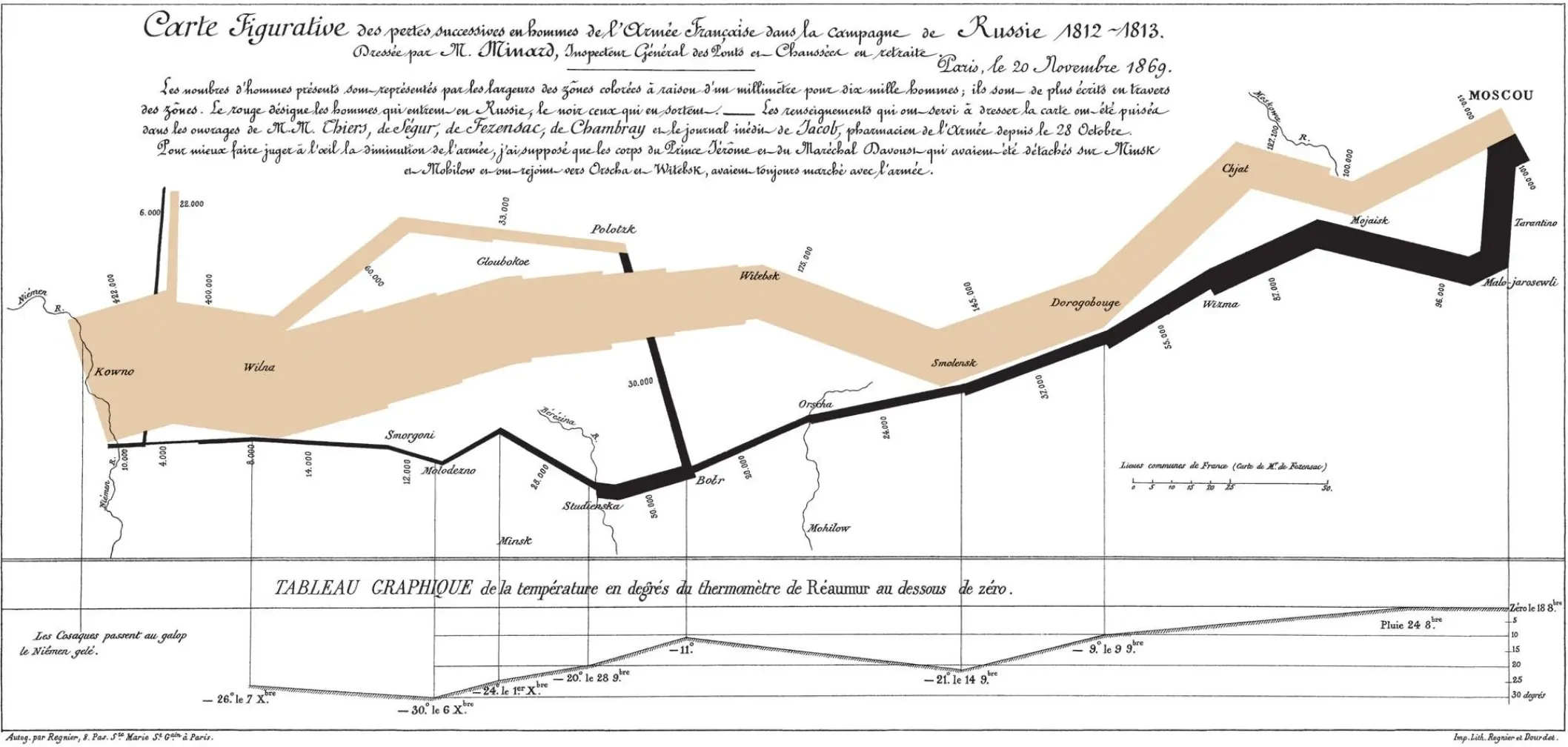
Charles Minard's 1869 map of Napoleon's Russian campaign - multivariate data visualization
Charles Joseph Minard's 1869 map of Napoleon's disastrous Russian campaign of 1812 - Public Domain

Tufte called this "probably the best statistical graphic ever drawn."10 Charles Joseph Minard's 1869 map masterfully reveals why Napoleon's Grande Armée was destroyed, not just what happened.

Army Size (Width)

The tan band's width shows 422,000 men advancing to Moscow; the black band shows only 10,000 returning - a visual representation of catastrophic losses that needs no explanation.

Geographic Path (Position)

The army's route is mapped precisely across European geography, showing exactly where losses occurred. The devastating crossing of the Berezina River becomes immediately apparent.

Temperature Timeline (Lower Chart)

The temperature graph below links specific dates to temperatures, plunging to -30°C (-22°F). When aligned with the geographic positions above, it reveals winter as the primary killer - not enemy combat.

Direction (Color)

Tan for the advance, black for the retreat - the color change marks the turning point at Moscow, where victory turned to disaster.

Minard doesn't tell you what caused the disaster - the graphic reveals it. The temperature line transforms a map of movements into an explanation of death. When you see the army's width shrink dramatically as temperatures plummet, causation becomes self-evident.

By integrating multiple variables in precise registration, causes emerge naturally from the data itself. The viewer discovers that the army was destroyed not by Russian military might, but by General Winter - a truth more powerful because you see it rather than being told it.

"Six variables are plotted: the size of the army, its location on a two-dimensional surface, direction of the army's movement, and temperature on various dates during the retreat from Moscow..." - Edward Tufte11

Modern examples like waterfall charts follow this principle - they show how you got from Point A to Point B through a sequence of contributing factors, making the mechanism visible.

3. Show Multivariate Data

The real world is complex. Oversimplified single-variable charts can mislead. Authoritative visualizations embrace complexity by showing how multiple variables interact.

Only shows revenue

Weak: Single Variable

Simple bar charts show only one dimension, missing the rich relationships between different data attributes.

Time → Revenue → Region Americas EMEA APAC Size = Units sold

Strong: Multiple Variables

Encoding time, revenue, region, and units sold in a single view reveals patterns impossible to see in isolation.

4. Integrate Evidence

Text, numbers, and graphics should work together seamlessly. The viewer shouldn't have to shuttle between a legend, a chart, and a separate text block to understand the message.

Product A Product B

Weak: Segregated Legend

Separate legend boxes force viewers' eyes to jump between data and labels, breaking the flow of information.

Product A Product B Labels on data

Strong: Integrated Labels

Direct labeling creates immediate understanding. No cognitive effort wasted matching colors to legend entries.

5. Document Everything

Credibility requires attribution. Every chart should clearly state its source, the time period covered, and any important caveats about the data.

Sales

Weak: No Attribution

Unattributed data lacks credibility. Viewers cannot verify claims or understand the context of measurements.

Q3 2024 Revenue Growth YoY change, seasonally adj. +12.4% Source: SEC 10-Q filings Research Dept., Oct 2024

Strong: Full Documentation

Complete attribution with sources, dates, and methodology builds trust and enables verification.

6. Content Above All

The design must serve the content, not the designer. "Chartjunk" - decorative elements that add no informational value - undermines authority by signaling that the data alone isn't compelling enough.

Weak: Chartjunk

3D effects, shadows, gradients, and excessive gridlines obscure the data. Visual decoration dominates information.

55 Q1 80 Q2 40 Q3 65 Q4 Clean, focused data

Strong: Data-Focused

Every pixel serves a purpose. Clean presentation lets the data speak clearly without unnecessary embellishment.

The Duck and Other Chartjunk

Tufte coined the term "The Duck" for graphics that sacrifice information clarity for artistic design - where the visual metaphor overwhelms the data. Named after a Long Island duck-shaped store, these charts prioritize form over function.12

Common Chartjunk to Avoid

  • 3D effects - they distort perception and make accurate value reading impossible
  • Excessive gridlines - heavy grids compete with the data for visual attention
  • Decorative backgrounds - gradient fills, textures, and images behind data create noise
  • Redundant encoding - using both color and pattern and labels to show the same thing

Applying These Principles

Tufte's principles aren't about making charts boring - they're about making them trustworthy. Here's a quick checklist for your next visualization:

Before You Publish

  • Is the data shown in meaningful comparison to something?
  • Does the design help explain why, not just what?
  • Have I shown the relevant complexity, or oversimplified?
  • Are labels integrated directly into the chart?
  • Is the source clearly documented?
  • Could I remove any element without losing information?

Final Thoughts

Tufte's influence extends far beyond academia. The Financial Times, The Economist, and top consulting firms all build on his foundation. Their charts work because they follow these principles - not as rigid rules, but as a mindset that prioritizes truth over decoration.

The goal isn't minimalism for its own sake. It's clarity. Every design decision should answer one question: does this help the viewer understand the data better?

References

  1. New York Times, "The Da Vinci of Data" - Profile of Edward Tufte
  2. Tufte, E. (1983). The Visual Display of Quantitative Information. Graphics Press.
  3. Tufte, E. (1990). Envisioning Information. Graphics Press.
  4. Tufte, E. (1997). Visual Explanations. Graphics Press.
  5. Tufte, E. (1983). The Visual Display of Quantitative Information, Chapter 4: "Data-Ink and Graphical Redesign"
  6. Tufte, E. (2006). Beautiful Evidence. Graphics Press. p. 127
  7. Tufte, E. (1983). The Visual Display of Quantitative Information, p. 57
  8. Tufte, E. (1983). The Visual Display of Quantitative Information, p. 57-60
  9. Huff, D. (1954). How to Lie with Statistics. W. W. Norton & Company.
  10. Tufte, E. (1983). The Visual Display of Quantitative Information, p. 40
  11. Tufte, E. (2006). Beautiful Evidence. Graphics Press. pp. 122-139
  12. Tufte, E. (1990). Envisioning Information, Chapter on "Chartjunk"

Related reading: The Aesthetic of Authority

Create charts that meet Tufte's standards - Install Chartbuddy for free.

Get Started for Free

No credit card required · Chrome & Edge