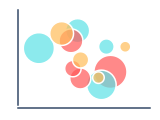
Scatter plot and bubble chart - definition, examples, and best practices.
To create a scatter plot or bubble chart in Google Slides, install Chartbuddy from the Chrome Web Store, open your presentation, select your data, and choose the scatter or bubble chart type. Chartbuddy plots your data with customizable axes, bubble sizes, and data labels, all natively inside your slide with live Google Sheets sync.
What is a scatter plot?
A scatter plot places individual data points on an x-y axis to reveal relationships between two variables. Each point represents one observation - its position on the horizontal axis shows one variable, its position on the vertical axis shows another. Unlike a line graph, no lines connect the points. The pattern of how the dots cluster, spread, or align tells the story.
Scatter plots are the primary tool for exploring correlation - whether two variables tend to move together, move in opposite directions, or have no relationship at all.
What is a bubble chart?
A bubble chart extends the scatter plot by adding a third variable: the size of each dot. Larger bubbles represent higher values of the third variable. This turns a two-dimensional comparison into a three-dimensional one, allowing you to see relationships between three measures simultaneously.
When to use scatter plots and bubble charts
These charts work best when you have a set of individual observations and you want to explore how two or three variables relate to each other. Typical use cases:
- Customer analysis - plotting acquisition cost (x) against lifetime value (y) to identify your most efficient channels. Add bubble size for customer volume to see the full picture
- Competitive landscape - mapping competitors by growth rate (x) and margin (y), with bubble size representing revenue. A classic strategy consulting framework
- Portfolio evaluation - plotting investments or business units by risk (x) and return (y), with bubble size for capital deployed
- Operational analysis - showing the relationship between production volume and defect rate across factory locations
- Correlation exploration - any time you're asking "do these two things move together?" a scatter plot is the starting point
How to read a scatter plot
Look for the overall pattern first. Do the points trend upward (positive correlation), downward (negative correlation), or show no pattern (no correlation)? Then look for outliers - data points that sit far from the main cluster often contain the most interesting insights. In a bubble chart, look for large bubbles in unexpected positions.
Best practices
- Label your axes clearly. Without labels, a scatter plot is meaningless - the reader needs to know what each dimension represents
- Highlight outliers or key data points with labels or a different color. In a competitive landscape chart, you'll want to call out your own company and key competitors
- Use quadrant lines where appropriate. Dividing the chart into four quadrants (e.g., high growth / high margin, high growth / low margin, etc.) turns an exploration tool into a strategic framework
- For bubble charts, include a size legend so the reader can estimate values. Without it, bubble sizes are ambiguous
- Don't overload the chart with too many data points. If you have hundreds of observations, consider using color or opacity to show density rather than plotting every point with a label
Create scatter plots and bubble charts in Google Slides with Chartbuddy
Build professional scatter plots and bubble charts directly in your presentation. Plot correlations, add bubble sizing, customize quadrant lines - all within Google Slides.
No credit card required · Chrome & Edge